The Geometry of Semantic Space: A Continuous Geometric Framework for the Transformer Architecture
Abstract
We present a continuous geometric framework that models the discrete algebraic operations of the Transformer architecture as an integro-differential equation (IDE) on a semantic fiber bundle ℰ = ℳ × ℝᵈ. Beginning from a single geometric axiom — that the token sequence forms a discrete 1-manifold equipped with a canonical measure lattice — we translate every core component of the modern Transformer (RMSNorm, RoPE, Softmax Attention, FFN, Residual Stream, SGD, Weight Decay) into a cohesive vocabulary of differential geometry, measure theory, and stochastic calculus. The resulting framework yields quantitative predictions spanning entropic optimal transport (Attention as a Schrödinger bridge) and non-equilibrium thermodynamics (SGD as Itô diffusion violating detailed balance). We conduct a six-part experimental campaign across five architectures (Qwen3, LLaMA-3.1, Gemma-3, GPT-2, Mistral) spanning 124M to 8B parameters. The empirical observables are quantitatively consistent with the geometric predictions: the ε^(−1/2) Lipschitz scaling calibration at machine precision (R² = 1.000), the Lie–Trotter operator-splitting torsion, the symmetric ablation instability confirming the Dual-Law of Topological Stability, the 𝒪(1/√k) thermodynamic suppression of Poincaré recurrence on the RoPE torus, the thermodynamic context-limit phase transition, and the Non-Equilibrium Steady State parameter vortex — verified across two optimizers (AdamW and Pure SGD) to exclude momentum artifacts. The results demonstrate that analyzing Transformers through the lens of continuous stochastic differential geometry provides a predictive descriptive vocabulary for the stability limits, context bounds, and optimization dynamics of Large Language Models.
本条目收录作者已在 arXiv 公开的论文 arXiv:2607.17146(v1,2026-07-19)。下方 PDF 与 HTML 版由本站从作者提交给 arXiv 的同一份 LaTeX 源码包编译;欢迎在本页逐条讨论、质疑与复核。
This entry records the author’s paper arXiv:2607.17146 (v1, 2026-07-19). The PDF and HTML versions below are compiled by Eksmu from the same LaTeX source package submitted to arXiv; technical criticism is welcome here, point by point.
- arXiv: https://arxiv.org/abs/2607.17146
- DOI: https://doi.org/10.48550/arXiv.2607.17146
- Subjects: Disordered Systems and Neural Networks (cond-mat.dis-nn); Computation and Language (cs.CL); Machine Learning (cs.LG)
License Copyright retained by the author. Distributed on arXiv under the arXiv.org perpetual, non-exclusive license (https://arxiv.org/licenses/nonexclusive-distrib/1.0/).
Previously published arXiv:2607.17146v1 — https://arxiv.org/abs/2607.17146 (DOI 10.48550/arXiv.2607.17146) · 2026-07-19 (author’s statement)
Materials in this version
- 2607.17146.tar.gz · LaTeX source archive 1.6 MiB · SHA-256 8fe99f0ca706ddc1…
- main.pdf · Read PDF online · HTML version · Compiled from source by platform · TeX Live 2026 · pdflatex · Source archive: 2607.17146.tar.gz 2.3 MiB · SHA-256 defedf711e00cf7e…
- main.html · HTML version · Converted from source by platform · LaTeXML 0.8.8 · Source archive: 2607.17146.tar.gz 4.5 MiB · SHA-256 2084a5d827e95d1f…
The HTML version is automatically converted from the LaTeX source by program; formulas and layout may differ from the PDF, and the PDF version is authoritative.
Attachments are stored as data; nothing in them runs on this site.
AI public analysis
The AI lists specific, located issues only. There is no score, and it never affects publication or ranking. The author and anyone else can accept or dispute each finding.
Deeper analysis paid by the author (same standard) · deepseek-flash · 2026-10-31
Summary
The entry records a paper titled "The Geometry of Semantic Space: A Continuous Geometric Framework for the Transformer Architecture", posted to arXiv as 2607.17146 (v1, 2026-07-19) and cross-listed under cond-mat.dis-nn, cs.CL and cs.LG. Judging from the title alone, the work proposes to describe the Transformer architecture within a continuous geometric framework, presumably connecting representation geometry to the statistical physics of disordered systems. The record supplied for review, however, contains only bibliographic front matter (title, arXiv identifier, DOI, subject classes) plus an editorial note that the PDF and HTML versions were compiled on the platform from the author's LaTeX source package. No abstract, theorem statements, derivations, experiments or reference list are present in the text I was given. Consequently the precise question, the construction and the claimed results can only be inferred from the title, and nothing in the body of the argument can be examined.
Assessment of the main claims
This is the model's opinion on whether the manuscript as written establishes each claim, not a verdict of the platform.
C1 · not assessed · Title
The Transformer architecture admits, or is best described by, a continuous geometric framework for 'semantic space'.
This is the only substantive assertion recoverable from the supplied record, and it is recoverable only from the title. No definition of the geometric structure, no statement of what is claimed to hold (a theorem, an approximation, an empirical regularity), and no supporting argument appear in the text provided, so there is nothing on the page against which to check it. This is an absence of material rather than a flaw in an argument.
C2 · not assessed · Subjects
The results are of interest to disordered systems and neural networks physics as well as to NLP and machine learning.
The cross-listing is a bibliographic fact about where the paper was posted, not a claim I can evaluate. Whether the content justifies the cond-mat.dis-nn classification would require seeing the formalism (e.g. whether a disorder average, a random-matrix or field-theoretic object is actually used) and the extent of any empirical validation; neither is present in the record.
Strengths
- The framing suggested by the title — treating Transformer representations through continuous geometry, and cross-listing to disordered systems — sits in a genuinely active interface between statistical physics and representation learning, and is a reasonable place to look for structure that purely combinatorial descriptions miss.
- The platform's arrangement of compiling the PDF and HTML from the author's own LaTeX source package, stated explicitly in the record, is a concrete reproducibility plus: readers can in principle check the typeset output against the submitted source.
Major issues
F1 · Major · Other · Front matter
**Subjects:** Disordered Systems and Neural Networks (cond-mat.dis-nn); Computation and Language (cs.CL); Machine Learning (cs.LG)
The record ends at the subject classification; no abstract, introduction, formal development, results or references are included in the material supplied. Since the entire argument is missing, no claim, derivation or comparison can be checked, and the report can only record that fact. Fix: include the full text (or at minimum the abstract plus the statements of the main results and the section structure) so that the geometric construction, its assumptions and its evidential support can be assessed.
Respond to this finding
Minor issues
F2 · Minor · Unsupported claim · Title
The Geometry of Semantic Space: A Continuous Geometric Framework for the Transformer Architecture
The title asserts a 'framework' for the Transformer as a whole. Titles of this scope routinely outrun what is delivered — often what is actually constructed is a description of one component (e.g. the attention map or the embedding layer) under strong idealising assumptions such as infinite width, Gaussian token distributions or a fixed number of layers. Fix: in the abstract, state explicitly which parts of the architecture the framework covers and under which limiting assumptions, and which statements are theorems as opposed to interpretive analogies.
Respond to this finding
F3 · Suggestion · Citation issue · Front matter
arXiv:2607.17146
The identifier and its v1 date (2026-07-19) could not be verified from the material supplied, and no reference list is present to check priority or overlap against existing geometric and statistical-physics analyses of attention and embeddings. Fix: ensure the identifier resolves and that the paper positions itself explicitly against the prior literature it builds on; a reader of this entry cannot do either from the front matter alone.
Respond to this finding
Questions for the author
- What exactly is the geometric object — a manifold of token representations, a metric induced by attention, a fibre bundle, or something else — and is it defined intrinsically or estimated from trained weights?
- Which statements are theorems, which are approximations valid in a stated limit (infinite width, large number of tokens, Gaussianity), and which are empirical observations?
- What concrete prediction does the framework make that a non-geometric description does not, and has that prediction been tested on a trained model?
- How does the framework relate to existing work on the geometry of contextual embeddings and on kernel/attention-as-smoothing views of Transformers?
- Why is the cond-mat.dis-nn classification appropriate — is a disorder average, random matrix ensemble or field-theoretic limit actually used?
- Is the framework intended as a description of trained networks, of the architecture's function class, or of the training dynamics?
Suggestions
- Supply the abstract and the statements of the main results so that the entry can be reviewed substantively; without them no technical judgement is possible.
- State each main claim in a numbered, self-contained form with its assumptions, and mark clearly which are proved, which are conjectured and which are supported only by experiment.
- Add at least one quantitative check against a trained Transformer (e.g. whether predicted geometric quantities such as curvature, effective dimension or distances match measured ones), with the protocol described well enough to reproduce.
- Include an explicit related-work comparison with prior geometric and statistical-mechanics treatments of attention and embeddings, so that the novel content is identifiable.
- Define all quantities in the framework before use, and give the units or normalisations in which geometric quantities are reported, since geometric claims are sensitive to scaling choices.
Overall comments
As supplied, the entry establishes only that a paper with this title exists at the stated arXiv identifier and subject classes; it does not put before the reader any argument that can be checked. The topic is worthwhile and the reproducibility arrangement around the source package is a genuine plus, but the substance — the definition of the geometric structure, the status of the main statements, the derivations and any empirical support — is entirely outside the material provided, so no claim about the framework is either supported or refuted here. A substantive assessment would require the full text, and in particular a precise statement of which parts of the Transformer the framework describes, under which limiting assumptions, and what observable evidence backs it.
Not checked: The full manuscript text (abstract, introduction, formal development, proofs, experiments, references), which is not present in the supplied record.;Whether arXiv:2607.17146 resolves and whether the compiled PDF/HTML match the LaTeX source, since the linked versions were not available to me.;The correctness of any derivation, the validity of any numerical experiment, and the accuracy of any citation, none of which could be inspected.;Whether the cond-mat.dis-nn cross-listing is substantively justified.;attachments, data files and code were not read
Sign in to respond to these findings one by one · Creating an account requires no academic credentials.
Cite this version
Plain-text citation
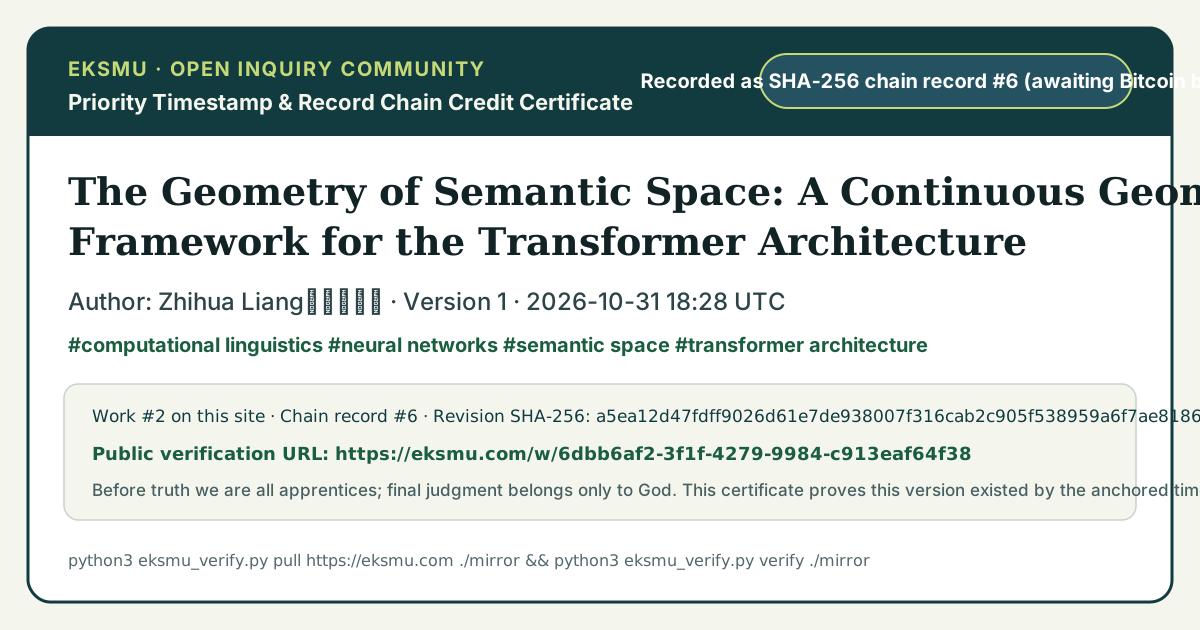
Zhihua Liang. The Geometry of Semantic Space: A Continuous Geometric Framework for the Transformer Architecture. Eksmu, version 1, 2026-10-31. https://eksmu.com/w/6dbb6af2-3f1f-4279-9984-c913eaf64f38
BibTeX
@misc{eksmu-6dbb6af2-v1,
  author = {Zhihua Liang},
  title = {{The Geometry of Semantic Space: A Continuous Geometric Framework for the Transformer Architecture}},
  year = {2026},
  month = {10},
  howpublished = {Eksmu},
  url = {https://eksmu.com/en/w/6dbb6af2-3f1f-4279-9984-c913eaf64f38},
  note = {Version 1; revision f74cf33d-bce7-41f3-b5d6-0bc162805ec6; SHA-256 a5ea12d47fdff9026d61e7de938007f316cab2c905f538959a6f7ae8186c9df6}
}
Version record f74cf33d-bce7-41f3-b5d6-0bc162805ec6 · content digest a5ea12d47fdff902…. The digest only shows the content is unchanged; it does not prove originality or correctness.
Time evidence
This version’s body is record #6 in this site’s record chain (which sequentially records all public accounts, works, versions, and discussions). After the daily timestamp anchor, a Bitcoin block can independently verify the latest time by which it existed.
Publication dates come from this site's clock; a Bitcoin anchor gives an upper time bound that does not depend on this site. Time evidence does not prove originality or correctness.
Discussion
No responses yet. A single question is a fine place to start.
Sign in to comment · Creating an account requires no academic credentials.